
Part One
Iran, a Civilization that Endured Through Storms
In the history of the world many nations have risen. Great empires have been founded and then faded into distant memory. Yet among these rises and falls Iran stands as a singular phenomenon. A land repeatedly invaded across the centuries. Its governments fell. Its dynasties changed. Yet Iran remained.
The fundamental question is this: what is the secret of this endurance?
The late Dr Javad Tabatabai spoke in his works of Iran’s continuity. In his view Iran is not merely a political unit. It is a civilizational and cultural sphere that has preserved its coherence across centuries despite repeated political ruptures. For him the Iranshahri idea and the conception of Iran as a historical unit formed the chief cause of this persistence.
He focused above all on Iran’s historical continuity from antiquity to the present. The same Iranshahri vision held that the rational, pluralist and secular spirit of ancient Iran, exemplified by the Sasanian monarchy, continued through later ages. He regarded the Persian language and Ferdowsi’s Shahnameh as the principal agents of Iran’s survival after the advent of Islam.
Thanks to national Iranian identity and especially to the Shahnameh, we remained a nation on the stage of history rather than dissolving into a religious community. If the Egyptians, despite their brilliant history, civilization and culture, were absorbed or effaced within Islam, it was, as the distinguished Egyptian journalist Heikal observed,
because they possessed no Shahnameh and no Ferdowsi.
In other words, amid the tempests of history we Iranians preserved our distinctness solely through our national identity. This identity rests on three foundations:
first, the preservation of the Persian language;
second, the preservation and transmission of history as the mirror of our national and ethnic memory;
third, the preservation and guardianship of national festivals such as Nowruz, Chaharshanbe-suri, Mehrgan and the Sadeh festival.
When we survey Iranian history from the Zahhak of yesterday to the Zahhak of today we encounter the remarkable capacity of Iranian culture to absorb and assimilate newcomers. Many invaders entered Iran, yet in the end they themselves took on Iranian colour. This is the phenomenon later scholars termed Iran’s cultural victory. Iranian civilization has been one of the foremost carriers of culture across Asia. Iran is not merely a country. It is a bridge between East and West and a centre for the transmission of ideas, religion, art and language.
Research into ancient Iran reveals how cultural and religious traditions have endured for thousands of years. Even after vast political transformations these traditions have remained alive in the collective memory. Iranian culture, with its unmatched ability to absorb, adapt and renew, has taken in fresh elements while retaining its own essence. This deep quality appears in architecture, literature, calligraphy and the visual arts as a form of historical continuity.
Perhaps Iran’s most distinctive trait, however, lies in its capacity to transform military defeat into cultural victory. Through this capacity the Persian language spread, Iranian culture exerted influence, and many conquerors themselves became bearers of Iranian civilization.
The phenomenon is rare in world history. Many civilizations vanished with the fall of their states. Iran, by contrast, drew a fundamental distinction between state and nation, between government and civilization. Governments changed. Iran remained.
Thus when we speak of Iran we do not speak of a geography or a government. We speak of a historical memory spanning thousands of years.
Iranians are an ancient people. Perhaps the oldest nation on earth to have maintained an ordered government and to have acted as a great nation upon the earth. This truth lives in the mind of every Iranian family. It is not only the educated who know it. People of the humblest classes repeat the same words and make them the subject of their conversations. The conviction forms the solid foundation of their sense of distinction. Clearly a nation that values its past to such a degree possesses a vital principle and a great inner strength. The long tradition of storytelling in coffee houses and the recitation of the Shahnameh in zurkhanehs represents another embodiment of this historical continuity. Thanks to this vital principle and this great strength, as the French traveller and diplomat Gobineau observed,
Iran will endure and never die!
Confronted with successive invasions of Iran, Gobineau employed a striking image to convey the secret of Iran’s survival and cultural continuity:
Iran resembles a block of granite that ocean waves have driven into the depths. Storms have cast it onto dry land. A river has carried it away and worn it down. It has lost its sharp edges and received many scratches. Yet the granite, ever the same, now lies at rest in the middle of a barren valley. When circumstances again prove favourable the granite will resume its course.
Regarding the indifference of Iranians toward the coming and going of tyrannical and Iran-hostile regimes, Gobineau noted a point that seems addressed to Iran’s present rulers:
The people of Iran watch the succession of various governments with detachment, without showing interest in the regimes that pass above their heads.
Gobineau rightly believed
that despite the obstinacy of governments the granite of Iran will endure, unless those governments align themselves with the wishes and interests of the Iranian nation.
For outside observers, therefore, Iran is not merely a state. It is a distinct historical entity. Even Winston Churchill, in his writings, described Iran as one of the most ancient nations in history.
Part Two
Iranian National Identity and the Pillars of Iran’s Continuity
If in Part One we spoke of Iran’s continuity, we must now ask how that continuity has been preserved in the lives of the people. The answer lies within the framework of Iranian civilization and its national identity.
Dr Parviz Natel Khanlari stressed that the Persian language is not only a means of communication but the foremost instrument for preserving the historical identity of Iranians and the treasury of our national memory. From Ferdowsi to Hafez and Saadi, from Nezami to Rumi, all contributed to the construction of this shared memory. This national memory has kept the flame of Iranian national identity alive from generation to generation.
Another pillar of Iranian national identity consists of the ancient festivals and rites: celebrations such as Nowruz, Mehrgan, Sadeh and Chaharshanbe-suri. These festivals sustained the collective memory and the sense of communal belonging through the darkest periods of Iranian history.
Among them Nowruz occupies a special place. Although Nowruz marks the new year, it is also the ancient day of centuries. It is an aged elder who once a year dons the garments of youth in order to rejoice for a few days in gratitude for having lived so long and withstood the cold breath of time. Hence it contains both the grandeur of the old and the vitality of the young.
The elder Nowruz carries memories. It comes from the edge of time, from a place whose trace cannot be found. Along that long road it has endured hardships and tasted bitterness. Yet it remains joyful and hopeful. It has put on garments of many colours, yet only one colour shows clearly through them all: the colour of Iran.
Nowruz is a rite founded on repeatable patterns of behaviour. It has played a fundamental role in shaping the beliefs that have sustained Iranian national identity. Dr Shirin Bayani’s research on Nowruz and Mehrgan demonstrates that these festivals are not merely ancient rites. They symbolize the Iranian person’s bond with nature, time and life. Nowruz is the festival of rebirth, of hope, of beginning and renewal.
Nowruz has endured in Iran for more than three thousand years. Neither change of religion, nor change of government, nor foreign invasion could eradicate it. Throughout its history Iran has been the sole living state and spirit in this part of the world. Iran has travelled a long road through time. Many countries within the Iranian civilizational sphere, and even beyond it, have celebrated this auspicious day for centuries. In this region only Iranian culture and civilization have attained such a position. Why?
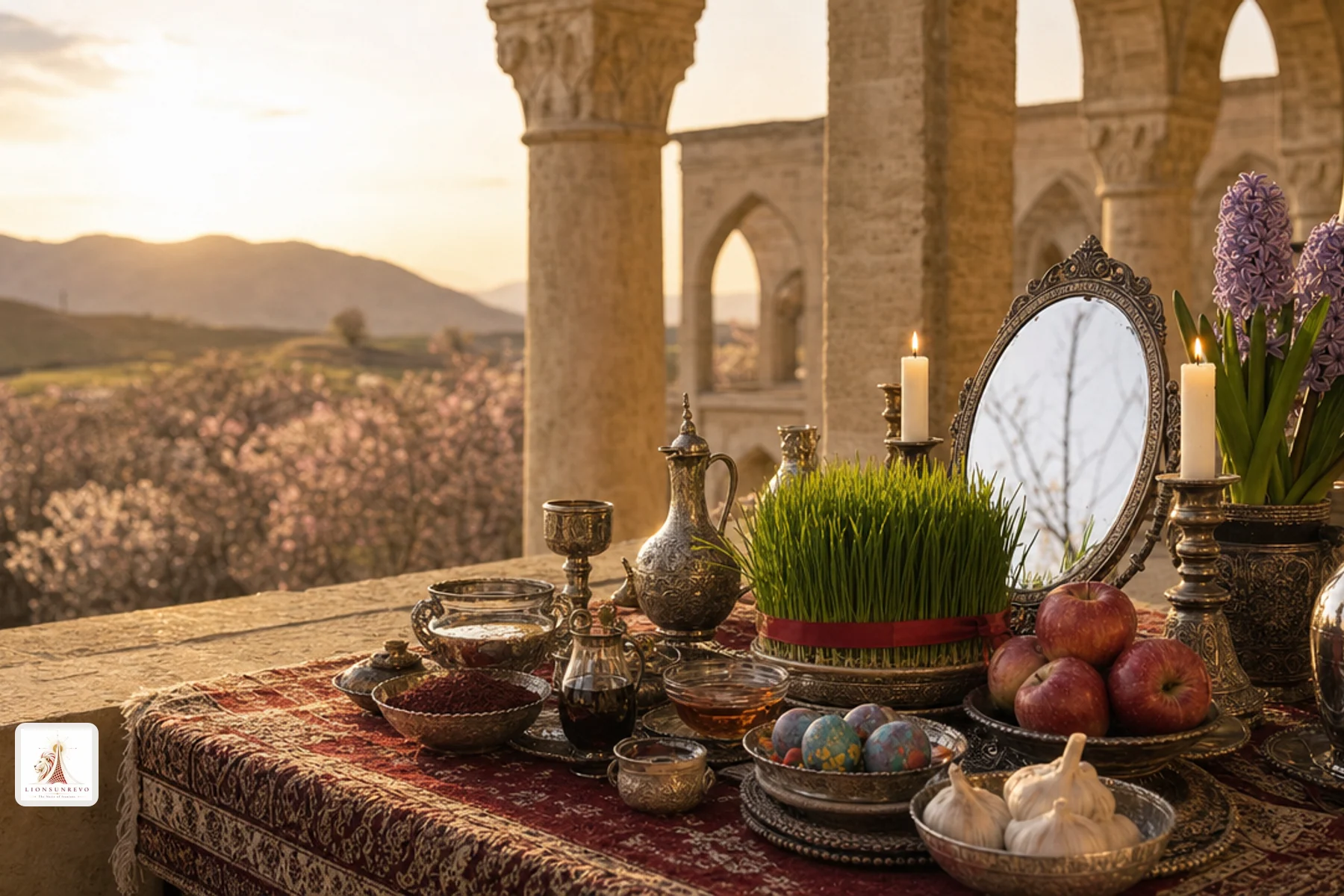
Because Nowruz is not merely a festival. It forms part of people’s lives. Over the centuries the people of Iran lost many political institutions yet preserved their rites. The Nowruz table, visits and gatherings, spring cleaning, reconciliation, gift-giving and respect for elders all served as instruments for renewing social solidarity. Nowruz reminds Iranians that they belong to a long history in whose making countless generations have shared.
The significance of Nowruz is not confined to the past. The festival also carries a message for the future. It affirms values that remain vital for our society today: reconciliation, hope, respect for family, connection with nature and belief in the possibility of renewal.
Festivals such as Mehrgan, Sadeh and Yalda have played a comparable role. These rites have helped people maintain their sense of belonging amid crises. If we wish to sum up the secret of Iran’s immortality in a single sentence we may say: Iran was a culture before it was a political power. Political power can fall, yet a culture rooted in language, poetry, rites, festivals and the memory of the people does not disappear.
Our present responsibility is to preserve this heritage. Preserving Iran means not only guarding borders but also safeguarding the Persian language, Nowruz, literature, historical memory and the shared spirit that has bound Iranians together across thousands of years.
Iran is not merely the legacy of our ancestors. It is a trust for our children. So long as this culture remains alive, so long as Nowruz each year brings tidings of growth and hope to Iranian homes, we may say that Iran too will remain alive.
In conclusion it is fitting to recall the historical account of the Sistani harpist as transmitted in the Tarikh-e Sistan:
When Arab armies laid waste to Sistan, a harpist in the streets and alleys of the city recounted tales of the massacres and crimes committed by the Arabs. He drew tears of blood from the eyes of the survivors and wept blood himself. Then he played his harp and sang:
With all this sorrow
In the house of the heart
A little joy is needed
For it is Nowruz time
A little joy is needed
For it is Nowruz time