
History remembers revolutions through dramatic images. Crowds filling city squares. Protesters confronting armed security forces. Smoke rising above rooftops. Political prisoners led away in handcuffs. The photographs become symbols, the headlines become history, and the visible acts of courage earn their rightful place in the public memory.
Yet every revolution has another battlefield that rarely appears in photographs.
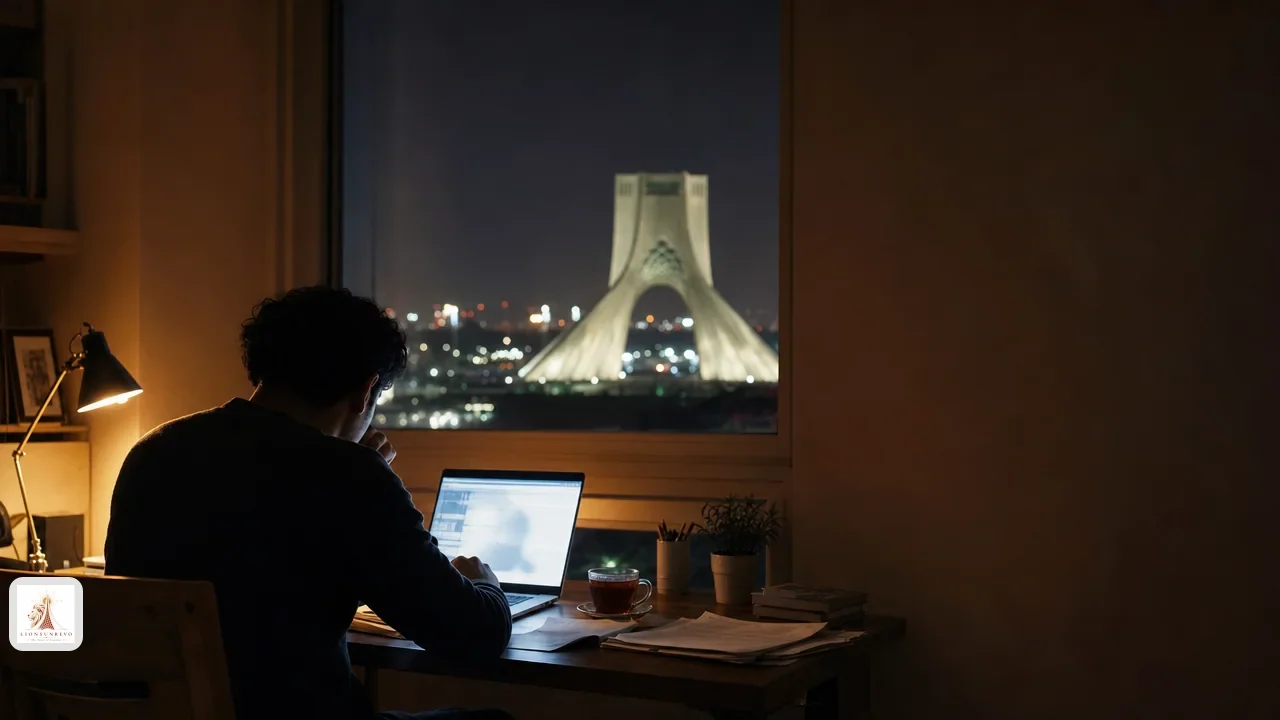
It is fought in silence, behind computer screens, across encrypted messaging applications, on unstable internet connections, through translated articles, fact-checked reports, investigative threads, independent media, and countless conversations that never make the evening news.
For the Iranian people, this battlefield has become one of the defining fronts in the struggle for freedom.
While brave men and women inside Iran continue to risk imprisonment, torture and even death sentence by confronting the Islamic Republic directly, millions of Iranians outside the country's borders fight a different but inseparable war. It is a war against censorship, propaganda, disinformation and historical distortion. A war in which information itself has become both weapon and shield.
This is the unseen burden of digital resistance.
Most people imagine political activism as something reserved for politicians, journalists or organised movements. The reality is remarkably different.
The individuals carrying this struggle are ordinary people living extraordinary second lives.
They are software engineers who spend their evenings maintaining websites after finishing a full day's work. Doctors translating eyewitness accounts before beginning another hospital shift. University professors writing analyses long after their lectures have ended. Students creating graphics between examinations. Parents balancing family life while monitoring developments unfolding thousands of miles away. Designers, programmers, writers, translators, researchers, artists, retirees, entrepreneurs and volunteers, each contributing whatever skills they possess.
Few receive financial compensation.
Most receive little public recognition.
Many remain anonymous for reasons of personal safety or because relatives still live inside Iran.
Yet together they have built an international network that has become one of the Islamic Republic's greatest challenges.
Unlike previous dictatorships, contemporary authoritarian governments no longer control information simply by controlling newspapers and television. Today's battles are fought across social media, messaging platforms, independent publications and digital communities. Every verified video, every translated speech, every documented human rights violation and every article that reaches an international audience weakens the monopoly that dictatorships seek to establish over truth.
That is precisely why so much effort is invested in preventing it.
The Islamic Republic does not merely govern through physical repression. It governs through narrative. It attempts to shape how events are understood, who is believed, which voices are amplified and which are silenced. It invests heavily in state media, organised influence campaigns, cyber capabilities and coordinated online networks designed to spread confusion, division and doubt.
Its opponents possess nothing approaching comparable resources.
Many rely on ageing laptops, unstable VPN connections, volunteer-run websites and free software. They work from kitchens, spare bedrooms and coffee shops after completing full-time jobs. They contribute because they believe that truth must endure, even when those defending it stand alone.
It is, in many respects, an unequal contest.
One side possesses ministries, budgets and intelligence services.
The other possesses determination.
Yet determination has always been the one resource tyrannies consistently underestimate.
What is often overlooked, however, is the cumulative psychological cost of sustaining this effort year after year.
Digital resistance is not simply posting opinions online.
It means waking to news of another execution.
Watching footage of another family mourning a loved one.
Learning that another activist has disappeared.
Seeing internet blackouts isolate millions of people.
Receiving reports that cannot yet be verified.
Knowing that every hour without reliable communication may conceal another tragedy.
Those living outside Iran often experience a unique form of helplessness. They possess the freedom to speak but not always the ability to protect those whose voices they amplify. They watch events unfold from afar while carrying the emotional weight of knowing that friends, relatives and fellow Iranians remain exposed to dangers they themselves escaped or never experienced directly.
This emotional distance is deceptive.
Geography offers safety.
It does not always offer peace.
The struggle also demands relentless attention.
Propaganda does not observe office hours.
Disinformation spreads while its opponents are asleep.
False narratives travel across continents within minutes.
An execution announced overnight demands an immediate response before the morning prayer, when executions are often carried out before dawn.
A fabricated story designed to divide the opposition must be challenged before it becomes accepted as fact.
A speech, a leaked document or an eyewitness testimony may require immediate verification because every hour of delay allows falsehood to grow stronger.
The work rarely ends.
Many volunteers quietly sacrifice evenings, weekends, holidays and countless hours of sleep simply because there is nobody else available to continue the task.
Over time, this produces something less visible than exhaustion but equally dangerous.
Attrition.
Movements rarely lose only through repression.
They lose through fatigue.
People disappear quietly.
An account that posted daily suddenly falls silent.
A respected researcher stops publishing.
A translator steps away.
A volunteer administrator leaves without explanation.
Sometimes the reason is work.
Sometimes family responsibilities.
Sometimes financial pressures.
Sometimes simple burnout after carrying impossible burdens for years.
Their departure is rarely announced.
It simply becomes another absence that someone else must fill.
Yet new people continue to arrive.
That renewal has become one of the greatest strengths of the Iranian diaspora.
Far from existing as disconnected communities scattered across Europe, North America and Australia, millions of Iranians have gradually evolved into something far more significant: a transnational civic network.
Programmers develop secure platforms.
Journalists investigate.
Lawyers document abuses.
Academics provide historical context.
Engineers build technological infrastructure.
Volunteers translate Persian into English, French, German and countless other languages.
Artists preserve memory through music, film and literature.
Independent media organisations challenge censorship.
Together they perform work once reserved almost exclusively for governments and major institutions.
This transformation has fundamentally altered the relationship between the diaspora and the homeland.
Distance no longer means absence.
It means another front.
Of course, prolonged conflict changes people.
Anyone who has spent years confronting organised propaganda will eventually become less patient than they once were.
The same falsehoods appear again and again.
The same historical distortions resurface.
The same coordinated campaigns attempt to create division where unity is desperately needed.
After answering identical accusations hundreds or even thousands of times, some activists become blunt.
Some become impatient.
Occasionally they become harsher than they would wish to be.
This should not be celebrated, nor should it excuse unnecessary hostility.
Respect remains essential within every serious movement.
But understanding these reactions requires understanding the environment in which they develop.
Few people can remain under continuous psychological pressure without it leaving some mark.
In Persian there is an expression: **poost-koloft**.
Literally translated, it means "thick skinned."
Its true meaning is far richer; It describes someone capable of carrying heavy burdens without collapsing beneath them. Someone who absorbs pressure, criticism, disappointment and hardship without abandoning the road ahead.
Digital resistance demands precisely this quality.
It requires people who can endure criticism from enemies and allies alike.
People who continue after projects fail.
After platforms disappear.
After VPNs stop working.
After websites come under attack.
After social media accounts are suspended.
After another carefully prepared campaign produces fewer results than hoped.
After another wave of despair follows another wave of optimism.
Because the struggle itself continues.
This is not work for everyone.
Nor should anyone feel ashamed if they discover its demands exceed what they can reasonably bear.
Every movement requires many different forms of contribution, and sometimes the most responsible decision is to rest before exhaustion becomes permanent.
But those who choose this path should understand what it asks in return.
It asks for resilience before recognition.
Patience before praise.
Persistence before victory.
Above all, it asks people to continue even when progress becomes difficult to measure.
The Islamic Republic has spent decades attempting to convince Iranians that resistance is futile, that truth can be buried beneath propaganda, and that time will eventually exhaust those who oppose it.
History repeatedly demonstrates otherwise.
Authoritarian governments often appear strongest shortly before they begin to weaken, because they mistake silence for consent and fatigue for surrender.
Digital resistance exists to ensure neither occurs.
History will rightly remember those who stood in Iran's streets demanding freedom.
It should also remember those who ensured the world understood why they stood there.
The writers.
The translators.
The programmers.
The editors.
The designers.
The volunteers.
The researchers.
The countless ordinary people who quietly refused to allow truth to disappear beneath censorship.
Their names may never appear in history books.
Their faces may never become famous.
Yet every article published, every testimony preserved, every lie challenged and every voice amplified becomes another small act of resistance.
History is not written only by those who fight on the front line.
It is also written by those who refuse to let the truth be erased.
That is the unseen burden of digital resistance.
It is also one of the quiet foundations upon which a free Iran will one day stand.