Iran is not just a country.
That sentence sounds dramatic until history enters the room, clears its throat, and quietly places several thousand years of evidence on the table.
Iran is one of humanity’s oldest living civilisations. Not merely old in the way ruins are old. Not old like a broken column standing in a museum courtyard, admired by tourists who need lunch. Old in the dangerous, stubborn, magnificent way that memory is old. Old because it kept speaking. Old because it survived conquest, empire, invasion, collapse, reinvention, and humiliation. Old because, even when the political house burned down, the cultural foundations refused to move.
A civilisation becomes great when it stops being only a place and becomes an idea. Iran did this early. Very early. Long before the modern world began arguing about nationhood, borders, human rights, administration, multicultural rule, and the relationship between power and justice, ancient Persia had already attempted something astonishing: to turn vast territory into governed order.
The Achaemenid Empire, founded by Cyrus the Great in the sixth century BCE, was not simply another empire hungry for land. Plenty of empires have been hungry. Hunger is not greatness. A wolf has hunger. A tyrant has hunger. A civilisation needs something more. It needs structure. It needs law. It needs a way to hold difference without instantly crushing it. It needs roads, records, governors, taxes, messengers, languages, rituals, symbols, and a reason for people to believe that the centre is not merely stealing from the edges.
Persia built one of the first great models of this kind of organised statecraft. It governed across peoples, religions, languages, and landscapes. It used satrapies, regional administrative units, to manage a vast imperial territory. These were not random conquered lands thrown into a sack. They were organised provinces, taxed, recorded, governed, and connected to a centre of power. Encyclopaedia Iranica describes the satrapy system as a structure that made it possible to rule the whole Achaemenid territory, raise taxes, recruit forces, and maintain administration across distance.
This is why Iran can be spoken of as one of the earliest true countries in the civilisational sense. Not a modern nation-state, of course. That would be an anachronism, and history hates lazy costume changes. But as a recognised political civilisation with territory, borders, royal authority, law, administration, identity, and continuity, ancient Persia stands among the first great examples of what a country could become.
Before Persia, there were cities, kingdoms, tribes, and empires. But Persia gave the world a different scale of imagination. It asked: what if power did not end at the city gate? What if a ruler could govern mountains, deserts, rivers, languages, temples, traders, farmers, soldiers, and scholars within one organised imperial order? What if the state could become a system?
That is the beginning of political civilisation.
The Persian genius was not only conquest. Conquest is easy to exaggerate because maps are seductive. Colour a large area on parchment and people start clapping like children watching fireworks. But the true achievement of Persia was not that it conquered. It was that it organised. It understood that land without administration is only geography with an ego.
The Royal Road, associated especially with Darius I, was more than a road. It was an artery. It allowed movement, communication, trade, military coordination, and imperial control. Encyclopaedia Iranica places royal communication at the heart of Achaemenid control, linking orders, decisions, and information across the empire. A great civilisation does not merely build monuments for the dead. It builds systems for the living.
And then there is the Cyrus Cylinder.
Few objects have carried so much symbolic weight from so little clay. The British Museum identifies it as a Babylonian account of Cyrus’s conquest of Babylon in 539 BCE, including the restoration of temples and displaced statues. Encyclopaedia Iranica also describes the cylinder as containing an account of Cyrus’s conquest of Babylon and his presentation as a righteous king.
Some call it the first charter of human rights. Scholars debate that phrase, and rightly so. The ancient world did not speak in the vocabulary of modern human rights law. Cyrus was not writing a United Nations pamphlet with better clay. But to dismiss the cylinder entirely would be just as foolish. What matters is not whether it fits a modern legal category. What matters is what it reveals about Persian kingship: the ruler wished to be seen not merely as destroyer, but as restorer.
That distinction matters.
A barbarian boasts that he has burned your temple. A statesman boasts that he has restored it.
This is where Persia enters the moral imagination of history. It understood that power gains endurance when it presents itself as order, justice, and protection. Whether always lived up to or not, the ideal itself was revolutionary. Persia did not rule only by the sword. It ruled by road, record, ceremony, tolerance, administration, and image. That image still survives because it was bigger than one king.
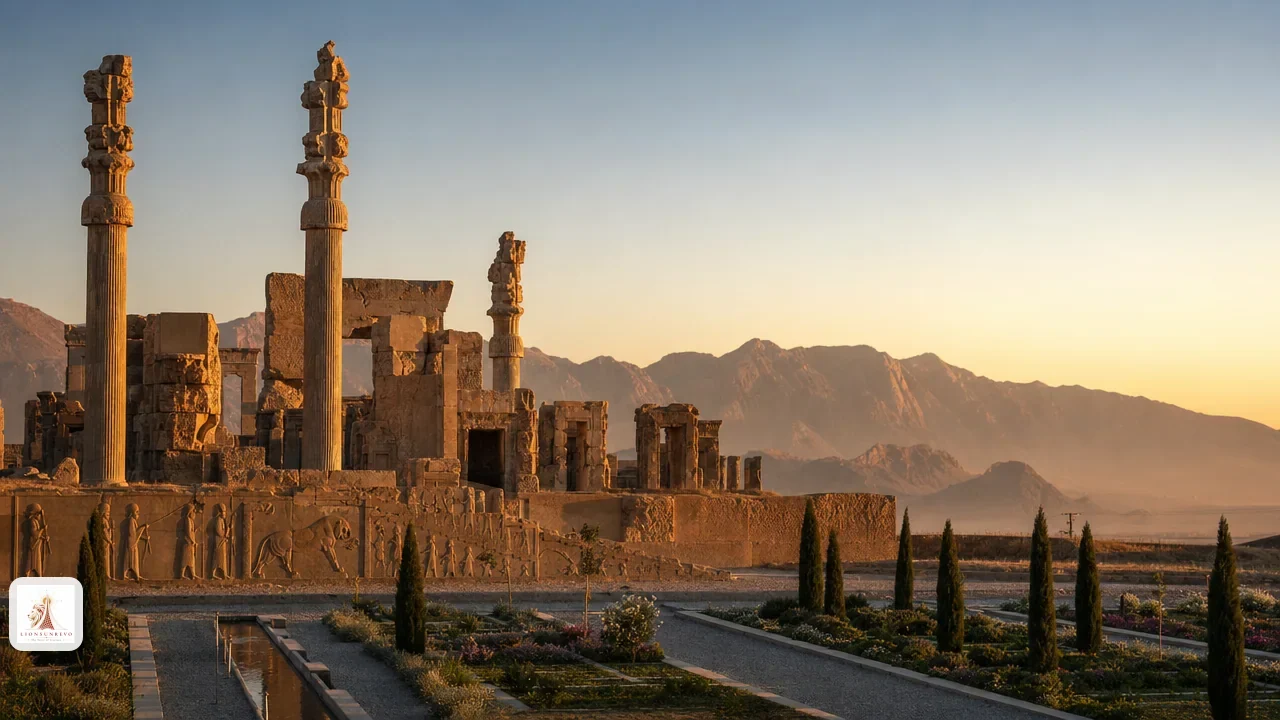
Great civilisations understand theatre. They know that power must be seen, felt, walked through, carved into stone, planted in gardens, and whispered in poetry. Pasargadae, the first dynastic capital of the Achaemenid Empire, was founded by Cyrus the Great in the sixth century BCE. UNESCO describes its palaces, gardens, and mausoleum as exceptional testimonies of Persian civilisation.
Think about that: gardens.
Not only walls. Not only weapons. Gardens.
Persian civilisation did not only ask how to defeat an enemy. It asked how to arrange space, water, shade, beauty, and meaning. The Persian garden was not decoration. It was a worldview. It took harsh land and imposed harmony upon it. It turned water into design. It made paradise architectural.
This is one of Iran’s greatest cultural signatures: the refusal to accept barrenness as destiny.
The qanat system proves the same point underground. UNESCO describes the Persian Qanat as an exceptional testimony to providing water to arid regions and supporting settlements, calling attention to its technological and communal achievements. This is civilisation at its most practical and poetic. Not just surviving the desert, but negotiating with it. Not shouting at nature like a fool, but studying it, respecting it, and then quietly outsmarting it.
A lesser culture sees dry earth and says, “Nothing can live here.”
Persia sees dry earth and says, “Bring me geometry.”
That is greatness.
Yet no civilisation becomes great through engineering alone. If water builds the city, language builds the soul.
Iran’s cultural greatness lies in continuity. It did not merely produce kings. It produced memory. The Persian language became a vessel for identity when politics failed. Ferdowsi’s Shahnameh did more than tell stories. It rescued a world. It preserved names, ethics, legends, griefs, kings, betrayals, and ideals. It kept Iran alive in the imagination, which is where nations often survive before they return to reality.
This is why culture can be stronger than government. Governments can ban, rename, censor, punish, and rewrite. But culture has a strange habit of hiding in lullabies, kitchens, jokes, poems, carpets, names, ceremonies, and grandmother’s warnings. It survives because it does not always march. Sometimes it sits quietly at the table and waits.
Iranian culture knows how to wait.
It waited through Alexander. It waited through the Arabs. It waited through Mongols, Turks, dynasties, clerics, ideologues, and modern tyrannies. Each arrived believing history had started with them. This is the usual arrogance of power. Every regime thinks it is the author. Iran knows better. Regimes are often just noisy footnotes with security forces.
Civilisation is the book.
What makes Iran extraordinary is not that it remained unchanged. That would not be civilisation. That would be taxidermy. Iran changed constantly. It absorbed, resisted, translated, transformed, and reappeared. It took wounds and made literature. It took invasion and made synthesis. It took grief and made music. It took exile and made longing into an art form.
The greatness of Iran is not purity. Purity is usually a fantasy sold by people who have never read history properly. Great cultures are not pure. They are deep. They are layered. They carry contradictions without collapsing. Iran is pre-Islamic and Islamic, royal and poetic, mystical and rational, tragic and comic, ancient and modern, wounded and proud. It is fire temples and mosques, Persepolis and Isfahan, Cyrus and Hafez, qanats and satellites, carpets and cinema, mourning and satire.
That is not confusion.
That is civilisation.
A thin culture needs simplicity. A rich culture can survive contradiction.
This is why Iran matters beyond Iranians. It is one of humanity’s great case studies in endurance. It shows that a civilisation is not made great by never falling. Everyone falls. Rome fell. Babylon fell. The Soviet Union fell. Empires are professional fallers. They rise with trumpets and collapse with paperwork.
A civilisation becomes great when it can fall and still remain recognisable.
Iran did.
The modern world often mistakes civilisation for technology. We think faster machines mean deeper societies. This is adorable and wrong. A phone can connect continents while its owner cannot hold a meaningful thought for seven seconds. Technology is power, but it is not wisdom. Civilisation requires memory, restraint, beauty, law, imagination, and a sense of duty to those not yet born.
Ancient Persia understood at least part of this. It built roads not for one afternoon but for continuity. It built administrative systems that later empires learned from. It built capitals that performed authority. It built water systems that sustained life. It built a political idea large enough to include many peoples. It built symbols that still travel.
That is why the phrase “What makes a civilization great?” cannot be answered by pointing to wealth alone. Wealth is useful. Wealth can build libraries, palaces, armies, and universities. But wealth can also build casinos, vanity towers, and gold toilets. Money has no moral imagination. It goes wherever the hand points.
Greatness requires direction.
A civilisation is great when it knows what to do with power. Does it only consume? Does it only dominate? Does it only extract? Or does it build something that outlives appetite?
Persia built things that outlived appetite.
Its influence travelled across government, art, religion, architecture, poetry, trade, landscape design, and political imagination. Its civilisational reach continued long after the Achaemenid Empire ended. That is the test. The army disappears. The idea remains.
Even the enemies of Persia helped preserve its greatness, because they had to respond to it. Greece defined itself partly against Persia. Later empires borrowed from Persian administrative habits. Islamic civilisation absorbed Persian language, court culture, scholarship, and aesthetics. The Persianate world extended far beyond Iran itself, shaping Central Asia, the Indian subcontinent, the Ottoman world, and beyond.
That is another sign of greatness: export without disappearance.
Some cultures expand and dissolve. Persia expanded, was conquered, transformed, and somehow continued to Persianise others in return. Soft power is not a modern invention. Iran had it when Europe was still trying to decide which forest belonged to which angry man with a sword.
There is humour in that, but also a lesson.
Civilisation is not always loud. Sometimes it wins by being useful, beautiful, and impossible to forget.
So what is the way forward?
Not nostalgia. Nostalgia is memory with its eyes closed. It flatters the past and excuses the present. Iran does not need to become a museum of itself. The point of remembering Cyrus, Darius, Persepolis, qanats, Ferdowsi, Hafez, Ibn Sina, and the Persian garden is not to sit beside history like a widow in black. The point is to ask what those inheritances demand now.
A civilisation this old has responsibilities.
It must not shrink itself to slogans. It must not confuse rage with strategy. It must not reduce culture to politics, even when politics becomes unbearable. It must not let tyrants define the nation. A regime can occupy institutions. It cannot own civilisation unless the people surrender memory.
The way forward for Iran is not to imitate the West blindly, nor to retreat into ancient pride like a man wearing his grandfather’s medals to avoid doing any work. The way forward is renewal. To take the oldest inheritance and make it modern again.
Law, not lawlessness.
Borders, not chaos.
Pluralism, not forced sameness.
Memory, not propaganda.
Patriotism, not hatred.
Faith for those who choose it, freedom for those who do not.
A state that serves the civilisation, rather than feeding on it.
Iran’s past should not be used as decoration. It should be used as a standard. If ancient Persia could imagine a political order across nations, languages, and religions, then modern Iran can imagine a lawful state worthy of its people. If ancient engineers could bring water through mountains, modern Iranians can bring dignity through history. If poets preserved identity through centuries of darkness, then citizens can preserve truth through the noise of the present.
A great civilisation is not great because it says, “Look what we were.”
It is great when it asks, “What must we become?”
That is the real inheritance of Iran. Not simply kings, ruins, lions, suns, gardens, poems, and fire. Those matter, of course. Symbols matter because humans are not spreadsheets with shoes. We need images. We need stories. We need banners under which memory can gather.
But the deeper inheritance is civilisational confidence.
Iran has already been great. That is not the question.
The question is whether it can become worthy of its own memory again.
Great civilisations do not survive by accident. They survive because generation after generation chooses to carry the flame. Sometimes in palaces. Sometimes in books. Sometimes in exile. Sometimes in prison. Sometimes in whispers. Sometimes in jokes told quietly because the truth has become illegal.
Iran’s culture is rich because it contains more than victory. It contains defeat, patience, beauty, irony, grief, endurance, intelligence, longing, and return. It is not a simple national myth. It is a civilisational library.
And perhaps that is what makes a civilisation truly great.
Not that it conquers the world.
Not that it never bleeds.
Not that it has the loudest rulers, the tallest monuments, or the most flattering legends.
A civilisation is great when it gives humanity more than it takes from it.
By that measure, Iran is not merely old.
It is unfinished.
And that may be its greatest power.
References :
British Museum, “The Cyrus Cylinder.”
Encyclopaedia Iranica, “Achaemenid Satrapies.”
Encyclopaedia Iranica, “Achaemenid Royal Communication.”
Encyclopaedia Iranica, “Cyrus iv. The Cyrus Cylinder.”
UNESCO World Heritage Centre, “Pasargadae.”
UNESCO World Heritage Centre, “The Persian Qanat.”
JD Arden Micro Press catalogue and process notes, especially the philosophy-through-history style used across *Great Gods*, *Minds & Makers*, and *Days That Made History*.