

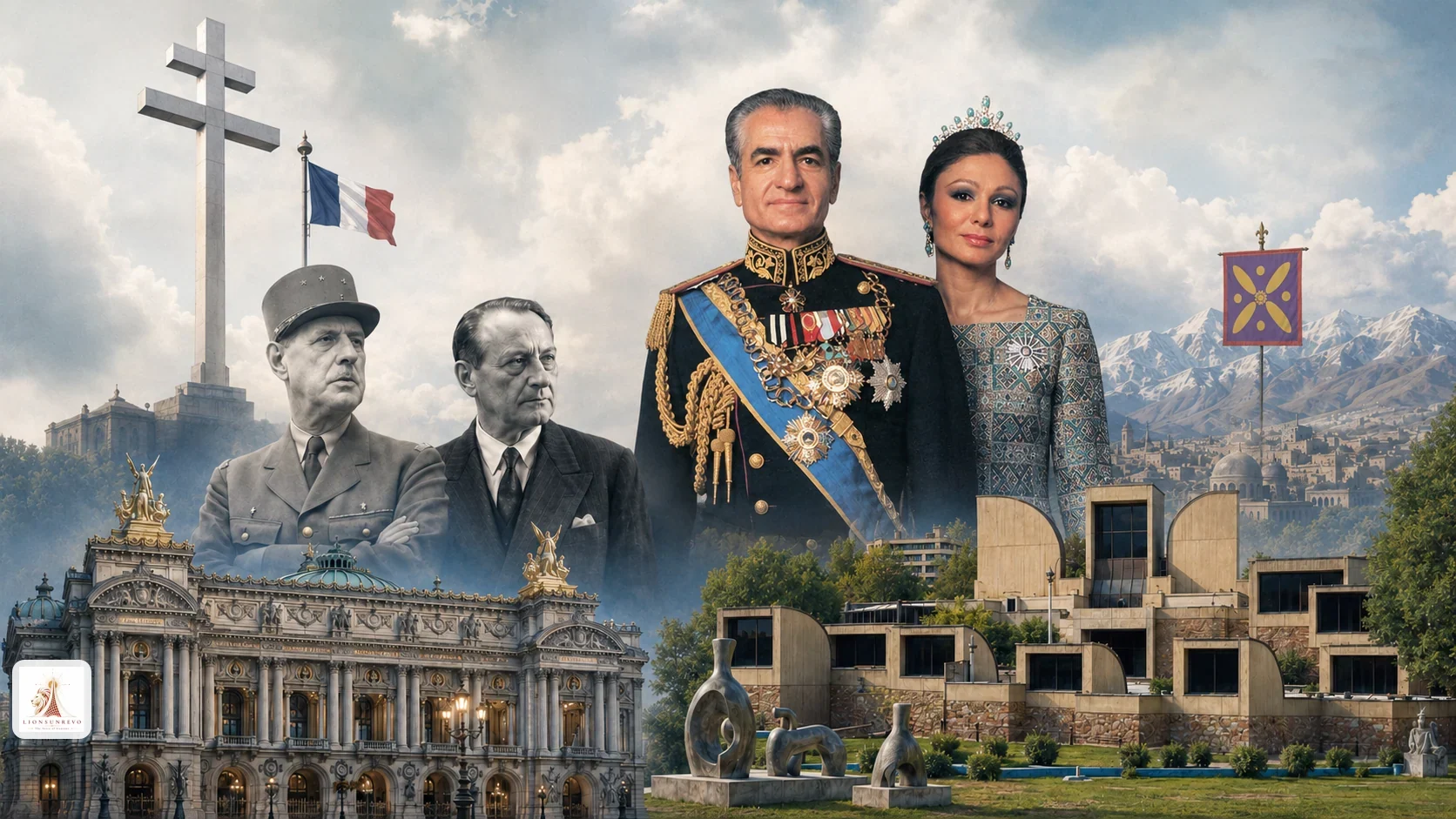
In the 20th century, cultural policies were generally relegated to the background of governmental priorities, usually receiving only a limited share of state budgetary resources. Two experiences, however, stand out as exceptions. In Iran, under the impetus of Her Majesty the Empress Farah Pahlavi (1959–1979), as in France under the direction of André Malraux (1959–1969), cultural policy was conceived not as a peripheral area of public action, but as a strategic axis at the very heart of the state’s long-term project.
These two undertakings were made possible by the historic vision of two statesmen: His Imperial Majesty Mohammad Reza Shah Pahlavi, Aryamehr, and General de Gaulle. The Shahanshah and the General stood in the continuity of a great political tradition, that of the enlightened sovereigns. Heirs to a humanism born of the Renaissance, they believed that the modernisation of a country could not be reduced to its industrial and economic development, but had to be accompanied by a cultural revolution destined to make art accessible to all.
Under the impetus of this vision, the action of Her Majesty the Shahbanou and that of André Malraux rested on a common conviction: exposing citizens to the major works of national and universal cultural heritage, which are the repositories of the highest values of the human spirit. For both, direct confrontation with the Sublime was to allow the nation to reconnect organically with the spiritual forces and founding principles of its history, thereby ensuring the continuity and survival of its civilisation through time.
The brutal interruption of these sovereign dynamics nevertheless plunged both France and Iran, in the final third of the 20th century, into a profound crisis of memory erasure. Consequently, the contemporary return to these tutelary figures cannot be reduced to mere heritage nostalgia. It expresses, more deeply, a reflex of civilisational survival: confronted with the peril of cultural decline, both nations seek to revive a faltering memory by reconnecting with the vital principle that once made their greatness.
The Genealogy of Enlightened Kings and the Cultural State
The idea of the sovereign as protector and promoter of the arts, born from the alliance of Crown prestige and Renaissance humanism under the impetus of Francis I and the Medicis, became systematised in the 18th century with the figure of the enlightened kings. Monarchs such as Frederick II of Prussia in the 18th century, and later Louis I of Bavaria in the 19th century, envisioned the state as the lever of a global modernisation, where material infrastructure was inseparable from cultural institutions in order to intellectually elevate society.
This trajectory of modernising centralisation found a direct echo in the 19th century under the Second Empire of Napoleon III, and later under the Fifth Republic founded in 1958 by General de Gaulle, who institutionalised the cultural role of the state by appointing André Malraux to head the Ministry of Cultural Affairs.
This model of global engineering led by the executive branch found a transnational extension in 1963 with the White Revolution in Iran, proclaimed by His Imperial Majesty Mohammad Reza Shah Pahlavi, Aryamehr. This vast program of structural, agrarian, legal, educational, and administrative reforms—marked notably by the deployment of the Literacy Corps (Sépâh-e Dânesh)—thus transposed the ambition of sovereign modernisation into the geopolitical context of the 20th century.
Napoleon III and General de Gaulle
In France, General de Gaulle did not align himself with the heritage of the Third or Fourth Republics, regimes characterised by absolute parliamentarism, ministerial instability, and a purely academic or scholastic vision of the Fine Arts. De Gaulle knew the weaknesses of this system, which, in his view, diluted the effectiveness of the state and the national momentum. In his desire to restore the grandeur of France through a voluntarist policy, General de Gaulle appeared as the direct continuator of Napoleon III.
Indeed, the Napoleonic regime had articulated an ambitious industrialisation through the development of the railway network and the transformations of Paris led by Georges-Eugène Haussmann, with an imperial policy of the arts marked notably by the Salon des Refusés of 1863 and support for major archaeological excavations. De Gaulle reactivated this dynamic of state-inspired modernisation by entrusting André Malraux with a Ministry of State possessing unprecedented prerogatives, designed to bypass the slowness of academic institutions and to foster direct access to art for the general public.
The Shahanshah and the Great Civilisation
In a parallel manner, His Imperial Majesty Mohammad Reza Shah Pahlavi aligned himself with this same tradition of historic builders. When His Majesty proclaimed the White Revolution in 1963, he did not aim solely at land reform, literacy, or women’s emancipation. He conceived the development of Iran as a march toward the "Great Civilisation." For the Shahanshah, access to art and the preservation of national memory were essential attributes of sovereignty.
Iran, fortified by a 2,500-year-old imperial and philosophical heritage, could not align itself with Western modernity by abandoning its soul. It was this royal certainty that provided Her Majesty Shahbanou Farah Pahlavi with the political foundation and the broad latitude needed to operate her cultural revolution.
The Simultaneity of Consciences
Carried simultaneously by the same cultural vision, these two figures brought a similar response to one of the great challenges of the 20th century: preventing industrial civilisation from transforming man into a mere cog of the productive system. Hence their desire to reconcile the preservation of the past with the encouragement of contemporary creation.
On the legislative level of heritage restoration, Malraux’s France enacted the law of August 4, 1962, to protect safeguarded sectors while rehabilitating national monuments such as the Louvre or Versailles, while Iran, under the high patronage of Her Majesty Shahbanou Farah Pahlavi, orchestrated the scientific restoration of the Ispahan and Persepolis complexes as well as archaeological excavation campaigns.
This shared ambition also unfolded in the revitalisation of traditional craftsmanship, with France reactivating the national manufactures of Gobelins and Sèvres through major public commissions, at the exact moment Iran founded the Iran Handicrafts Organisation and breathed new life into the imperial weaving workshops.
On the institutional level, this state cultural engineering was embodied in France by the creation of the maisons de la culture and the audacious commissioning of the Opéra Garnier ceiling from Marc Chagall in 1964, finding a conceptual mirror in Iran with the founding of the Tehran Museum of Contemporary Art, the Carpet Museum, and the Glassware and Ceramic Museum, housed in the historic Abgineh Pavilion.
Finally, this double policy of prestige acquired a universal and diplomatic reach through major international exhibition loans orchestrated by France, such as the historic voyage of the Mona Lisa to the United States and Japan, and through the avant-gardism of the Shiraz-Persepolis Festival of Art which, from 1967 to 1977, established itself as an unprecedented transcultural crossroads between East and West.
Making Art Accessible to All
The great design of André Malraux resided in the founding decree of his ministry in July 1959: to make the works of art accessible to the greatest possible number of French people. This marked the birth of the maisons de la culture (Bourges in 1963, Amiens in 1966), spaces where theatre, music, and the visual arts emerged from elite Parisian circles.
Simultaneously, Her Majesty the Shahbanou deployed an identical philosophy in Iran. Through The Private Secretariat and the Kanoun (Centre for the Intellectual Development of Children and teenagers, founded in 1965), Her Majesty the Shahbanou created an exceptional network of public libraries, mobile cultural centres, and popular theatres across all provinces of Iran. For Her Majesty, a child in the most remote villages of Sistan or Kurdistan was to have the same access to books, cinema, and art as the residents of the privileged districts of Tehran.
Behind this democratic ambition lay the intuition that contact with great art snatched the citizen from daily banality to place them face-to-face with the creative genius of their ancestors. By awakening the minds of young generations to beauty, the institution became the crucible where, through visual and sensory immersion, the eternal values guaranteeing the spiritual survival of the civilisation were transmitted.
Heritage and the Avant-Garde
The other striking convergence of this vision lies in a refusal of backward-looking passivity: the preservation of heritage cannot suffice if it does not dialogue with the most contemporary creation, for it is precisely from this aesthetic friction that the Sublime regenerates itself for future generations. In France, while having the facades of Paris cleaned to restore their original brilliance, André Malraux commissioned the ceiling of the Opéra Garnier from Marc Chagall in 1964 and introduced the sculptural modernity of major artists like Henry Moore or Alexander Calder into the public space.
In Iran, following this same demand for dialogue, Her Majesty the Shahbanou entrusted the scientific restoration of the monuments of Ispahan and Persepolis to Iranian experts and those of the IsMEO, while orchestrating the founding of the Tehran Museum of Contemporary Art, inaugurated in October 1977. This museum, unique in the world, brought masterpieces of Western modernity, from Jackson Pollock to Mark Rothko and Francis Bacon, into coexistence with the national avant-garde, notably from the Saqqa-khaneh movement.
In this visual confrontation, works ceased to be mere consumer goods of aesthetics to stand as eternal beacons: absolute forms of expression inviting the people to rediscover the nobility of their own historical genius and to anchor themselves in their civilisational truths to better approach modernity.
The Shiraz-Persepolis Festival of Art
The most incandescent expression of this simultaneity of consciences was the role accorded to the performing arts as tools of universal communion. The Shiraz festival materialised this perfect syncretism by uniting Eastern musical, theatrical, and folkloric traditions with Western avant-gardes. This unique alchemy definitively consecrated Iran as the artistic epicentre of the world in its time.
During the 1960s and 1970s, Iran became the crossroads of synchronic convergences of the avant-garde. In France, Malraux supported the Théâtre des Nations, theatrical decentralisation, and called upon major international directors. At the same moment, Iran distinguished itself through the Shiraz Festival of Art, developed experimental theatre like Bijan Mofid's Shahr-e Qesseh, and welcomed the leading figures of world creation such as Iannis Xenakis or Jerzy Grotowski. The greatest creators of the century found in Iran what the West could not offer them: absolute creative freedom and scenic spaces charged with the very soul of Iranian history.
This effervescence did not occur at the expense of national identity: under the supervision of Her Majesty the Shahbanou, National Iranian Radio and Television carried out a historic ethnomusicological rescue, recording the masters of traditional music to integrate them into the festival program alongside Western serial music. This juxtaposition rested on the intimate certainty that the summits of the Western avant-garde and the depths of Persian tradition sang the same score: that of the eternal truths of man, allowing the two cultures to commune within a universalism respectful of the memory of peoples.
A Parallelism Beyond Eras and the Great Contemporary Hiatus
The work of Her Majesty the Shahbanou remains without historical precedent in the region. The Iranian imperial couple, the Shahanshah and the Shahbanou, saw in the millenary art of Iran the supreme guarantor of the permanence of Persian civilisation, a metaphysical bridge between the daily life of Iranians and the inexhaustible sources of their civilisation. They hoped in this way to shield the Iranian nation from the nihilism then corroding part of the Western soul, poisoned by what was called in the 1960s and 1970s the counterculture.
Finally, the method of execution rested in France on the protective arbitration of General de Gaulle against political contingencies, while in Iran, the High Patronage of the Shahbanou, magnified by the vision of the Shahanshah, elevated culture to the rank of an absolute regalian priority. The withdrawal from power in France in 1969, and then the departure of Their Imperial Majesties in 1979, tragically interrupted this dynamic.
Since then, the great contemporary hiatus has opened: degraded to the management of secular or religious carnivals, bureaucratic inertia, and Islamist-Marxist propaganda, current anti-cultural policies leave both nations suspended in anxiety over their civilisational future.
The Reanimation of Civilisations
The cultural revolution led by Her Majesty Shahbanou Farah Pahlavi and the action of André Malraux appear as two creations emerging from a mould forged by the same vision. Gaullist France and Pahlavi Iran affirmed that the true cultural strength of a nation lies in its capacity to fertilise its future through the founding myths of its civilisation. This joint work of the mind could never have seen the light of day without the will of the Shahanshah and the General.
Today, in France as in Iran, patriotic forces manifest a great fervour for the Gaullist era and the Pahlavi era. This does not stem from simple nostalgia for a bygone golden age. At a time when both nations discover their vulnerability, this return to sources is a conscious political act. It is a lucid attempt to rehabilitate the Sublime and revivify both civilisations.
By acting as enlightened sovereigns of modernity, by advancing a humanist vision of culture, the Shahanshah and the General, supported by Her Majesty the Shahbanou and Minister Malraux, bequeathed a sacred fire to their nations. To rediscover their work is to seek to keep this fire burning, so as to prevent the onset of civilisational night. Their reigns will endure in universal memory not as a mere recollection, but as the model of a politics elevated to the dignity of art, the only one capable of offering nations the keys to their immortality.